

A minimum viable product (MVP) for a mobile app is the smallest working version of your product that solves one specific problem for real users and generates measurable feedback. The mobile app MVP development steps you follow in the first weeks of a project determine whether you spend six months building something users actually want or something they ignore. Founders who skip structured validation and feature discipline routinely burn through runway before finding product-market fit. This guide walks you through each stage of the MVP mobile application process, from problem validation through launch and iteration, with concrete tools and benchmarks at every step.
What are the mobile app MVP development steps?
The mobile app MVP development steps begin before a single line of code is written. They start with a precise problem statement, not a feature list. Most early-stage teams make the mistake of defining their MVP as a smaller version of their full product vision. That approach produces a bloated scope that delays launch and muddies the data you collect. The correct starting point is a single, falsifiable hypothesis: “Users in [segment] struggle with [problem], and our app will solve it by [mechanism].”

How to validate your problem before building
Validation is not optional. It is the step that separates funded, growing startups from expensive side projects. The two most reliable validation methods are direct user interviews and a pre-launch landing page. Interviewing 20 to 30 potential users and achieving a landing page conversion rate of at least 5% are the quantitative benchmarks that confirm real demand before you write any code. A 5% conversion rate means at least 1 in 20 visitors signed up or expressed intent, which is a meaningful signal that the problem resonates.
Validation methods worth running in parallel include:
- User interviews: Recruit 20 to 30 people who match your target profile. Ask about their current behavior, not their opinions about your idea.
- Landing page test: Build a one-page site describing the problem and solution. Drive paid or organic traffic and measure sign-ups.
- Competitor review mining: Read one-star reviews of competing apps on the App Store and Google Play. These reviews are a free, unfiltered catalog of unmet needs.
- Smoke test ads: Run a small Facebook or Google Ads campaign to a waitlist page before building anything.
- Community listening: Monitor Reddit threads, Slack groups, and LinkedIn posts where your target users discuss their frustrations.
Pro Tip: One-star reviews on competing apps are the most underused research tool in early-stage product development. They tell you exactly what users hate about existing solutions, which is precisely the gap your MVP should fill.
The output of this phase is a written problem statement, a defined user segment, and at least one validation signal. Without those three elements, moving to feature definition is premature.
How do you decide which features belong in your MVP?
Feature prioritization is where most MVPs go wrong. Founders fall into what practitioners call the feature trap, trying to shrink their full product vision rather than defining a single core user flow. The result is an app with eight half-working features instead of one feature that works perfectly.
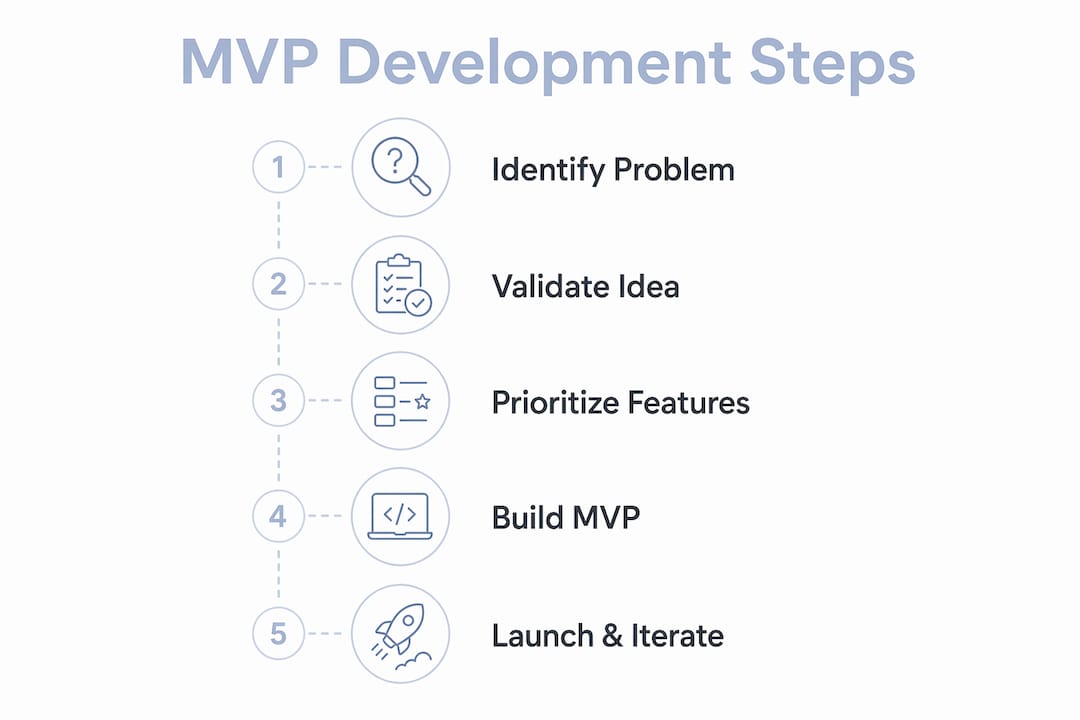
The MoSCoW method (Must Have, Should Have, Could Have, Won’t Have) is the standard framework for building a mobile app MVP features list. Apply it ruthlessly. Anything that does not directly enable the core user action belongs in the “Won’t Have” column for version one.
A well-scoped MVP is limited to 2 to 4 core screens enabling one primary user action completed within 30 seconds. That constraint forces clarity. If your onboarding takes three minutes, you have already lost a significant portion of first-time users before they experience any value.
| Category | Examples | Include in MVP? |
|---|---|---|
| Must Have | Onboarding, core action screen, basic feedback | Yes |
| Should Have | User profile, notification preferences | No, post-launch |
| Could Have | Social sharing, gamification, advanced filters | No |
| Won’t Have | Admin dashboard, third-party integrations, analytics UI | No |
Pro Tip: For every feature on your list, ask: “Can I remove this and still deliver the core value?” If the answer is yes, remove it. Apply this test until you cannot remove anything else without breaking the primary user flow.
A true MVP focuses on one clear use case and works from start to finish without friction. It is not a feature-complete product at smaller scale. It is a single, polished user journey that proves or disproves your core hypothesis.
Which tech stack should you choose for a mobile app MVP?
Technology decisions at the MVP stage carry long-term consequences, but they should not slow you down. The primary trade-off is between speed and control. Cross-platform frameworks like Flutter and React Native are the right choice for most startups because they reduce development cost by 30 to 40% compared to building separate native iOS and Android apps. That cost reduction translates directly into more runway for iteration.
| Tech Option | Best For | Key Trade-off |
|---|---|---|
| Flutter | Cross-platform mobile MVPs | Smaller talent pool than React Native |
| React Native | Teams with JavaScript experience | Performance ceiling for complex animations |
| Progressive Web App | B2B tools, ecommerce MVPs | No app store distribution |
| Native iOS/Android | Performance-critical, hardware-dependent apps | 2x cost and timeline |
Progressive Web Apps deliver roughly 80% of the native app experience at a fraction of the cost and without requiring app store approval. For B2B tools or ecommerce MVPs where users access the product via a shared link rather than browsing an app store, a PWA can cut weeks off your timeline.
On the backend, building your MVP as a set of APIs from day one is the single most important architectural decision you can make. An API-first backend powers your mobile app today and can support a web dashboard, partner integrations, or a second product surface tomorrow without duplicating logic. Pair that with a modular architecture where individual features can be upgraded or replaced independently, and you avoid the full rewrite that kills so many post-MVP growth phases.
Budget planning for a mobile MVP should account for design, development, testing, and a post-launch iteration cycle. Skipping budget for the iteration cycle is a common mistake. The first version will need changes based on real user behavior, and those changes require resources.
Pro Tip: For UX/UI design at the MVP stage, prioritize clarity over aesthetics. A confusing interface with beautiful visuals fails faster than a plain interface with an obvious user flow.
How do you launch, measure, and iterate your MVP?
Launching a mobile MVP is not a single event. It is a phased process designed to generate clean, actionable data without exposing an unproven product to a mass audience.
- Closed beta: Recruit 50 to 200 users from your validation interviews and waitlist. Give them direct access and collect qualitative feedback through in-app prompts and follow-up calls.
- Soft launch: Release to a limited geographic market or a specific user segment. Monitor crash rates, onboarding completion, and core action completion before expanding.
- Instrument before you launch: Integrate analytics tools like Mixpanel or Amplitude before the first user touches the app. Retroactive analytics setup means lost data.
- Define your success metrics in advance: Decide what “validated” looks like before you see the numbers. Post-hoc metric selection leads to confirmation bias.
- Collect qualitative feedback in-app: Use tools like Typeform or a simple in-app prompt to ask users what is missing or confusing immediately after they complete the core action.
- Review data weekly, not monthly: MVP iteration cycles should be measured in weeks. Monthly reviews slow the learning loop and burn runway.
The two metrics that define MVP validation are retention above 25% at 90 days and core action completion rate. Retention above 25% at 90 days means users are returning after the novelty wears off, which is the clearest signal of genuine value. Core action completion rate tells you whether users can actually solve the problem your app promises to solve.
When the data comes in, the decision framework is straightforward. Iterate when your core hypothesis holds but the UX needs refinement. Pivot when the core assumption proves false based on usage data, not when a few users complain. Fast iteration after MVP launch consistently outperforms months of preparation trying to perfect version one. The learning comes from usage, not planning.
Key takeaways
Successful mobile app MVP development requires problem validation before coding, ruthless feature prioritization down to a single core user flow, and a structured launch-and-measure cycle that treats every release as a learning experiment.
| Point | Details |
|---|---|
| Validate before building | Interview 20 to 30 users and hit 5% landing page conversion before writing code. |
| Limit scope aggressively | Restrict your MVP to 2 to 4 screens and one primary action completable in 30 seconds. |
| Choose cross-platform tech | Flutter or React Native cuts development cost by 30 to 40% versus native builds. |
| Build API-first from day one | A modular, API-first backend lets you scale without a full rewrite post-launch. |
| Measure retention, not downloads | A 90-day retention rate above 25% is the clearest signal of real product-market fit. |
Why most MVPs fail before they get a fair test
I have reviewed dozens of early-stage mobile products over the years, and the pattern that kills most of them is not bad technology or poor design. It is the refusal to accept that an MVP is a learning tool, not a launch vehicle. Founders treat the MVP launch as the finish line when it is actually the starting gun for the real work.
The second most common failure is equating MVP with a half-baked product. Minimal does not mean sloppy. If your one core feature crashes, confuses users, or delivers a broken experience, you are not collecting valid data. You are collecting noise. The feedback you get from a broken MVP tells you nothing useful about whether the underlying idea has merit.
What I have seen work consistently is a team that defines one user flow, makes that flow excellent, ships it to a small audience, and then treats every piece of usage data as a question to answer rather than a verdict to accept or reject. The founders who fall into the feature trap are almost always the ones who never clearly defined what “validated” would look like before they launched. Set that definition before you write the first line of code. It changes everything about how you read the data that comes back.
— Christopher
Build your mobile app MVP with Mediakliq
Mediakliq has delivered over 75 completed projects and more than 100,000 project hours across mobile and web products, working with startups that needed to move from idea to validated product without wasting capital on features that do not matter.
If you are at the validation or build stage of your MVP, Mediakliq’s team works across Flutter, React Native, and Laravel to deliver cross-platform mobile apps built on API-first architectures from day one. Their MVP development services cover the full lifecycle: scoping, design, development, and post-launch iteration support. For startups that need a product ready for investor demos or early user testing, that end-to-end capability matters. Explore how Mediakliq can help you launch your mobile app faster and with less risk.
FAQ
What is an MVP in mobile app development?
A mobile app MVP is the smallest working version of your app that solves one specific problem for a defined user group. It contains only the features required to test your core hypothesis and collect real user feedback.
How many features should a mobile app MVP have?
A well-scoped MVP covers 2 to 4 core screens and enables one primary user action completable within 30 seconds. Anything beyond onboarding, the core action, and basic feedback belongs in a later release.
How long does it take to build a mobile app MVP?
Most mobile MVPs built on cross-platform frameworks like Flutter or React Native take 8 to 16 weeks from scoped requirements to soft launch, depending on backend complexity and design requirements.
How do you know if your MVP is validated?
The two primary validation metrics are a 90-day retention rate above 25% and a high core action completion rate. Both must hold before you treat the MVP as validated and commit to scaling.
Should you use Flutter or React Native for an MVP?
Both are strong choices for MVP builds. Flutter offers a more consistent UI across platforms, while React Native suits teams with existing JavaScript experience. Either framework reduces development cost by 30 to 40% compared to native builds.