

Cross-platform app development is defined as writing a single codebase that runs on Android, iOS, web, and desktop simultaneously. This is exactly why startups need cross-platform apps: one team, one build, and full market coverage from day one. Frameworks like React Native and Flutter have made this approach the default choice for resource-conscious founders. The performance gap between cross-platform and native has closed to the point where most business apps are indistinguishable to users. For startups racing to validate ideas and capture users, that combination of speed, cost, and reach is decisive.
Why startups need cross-platform apps: the core benefits
The most direct benefit is cost reduction. Startups using cross-platform frameworks reduce development costs by 30–40% compared to building separate native iOS and Android codebases. Annual maintenance costs can drop by as much as 50% when all logic lives in one shared codebase. That is not a marginal saving for a seed-stage company. It is often the difference between shipping a product and running out of runway.

Speed is the second major advantage. Cross-platform development enables shipping an app 40% faster initially than native builds. Subsequent feature updates are approximately 12% faster with cross-platform over native. For a startup iterating on user feedback weekly, that compounding speed advantage adds up fast.
The third benefit is reach. One codebase deploys to Android, iOS, web, desktop, and embedded systems simultaneously. A startup targeting both mobile and web users does not need to choose one platform first. It launches everywhere at once.
- Cost savings: 30–40% lower development costs and up to 50% lower maintenance costs
- Speed to market: Initial builds ship 40% faster than native equivalents
- Multi-platform reach: Single codebase covers Android, iOS, web, and desktop
- Smaller teams: A two-person team can achieve what previously required five developers for dual native builds
- Fewer bugs: Shared logic means defects are fixed once and resolved everywhere
Pro Tip: Redirect the budget you save on duplicate development toward user research and product iteration. That is where early-stage startups win or lose.
How does cross-platform compare to native app development?
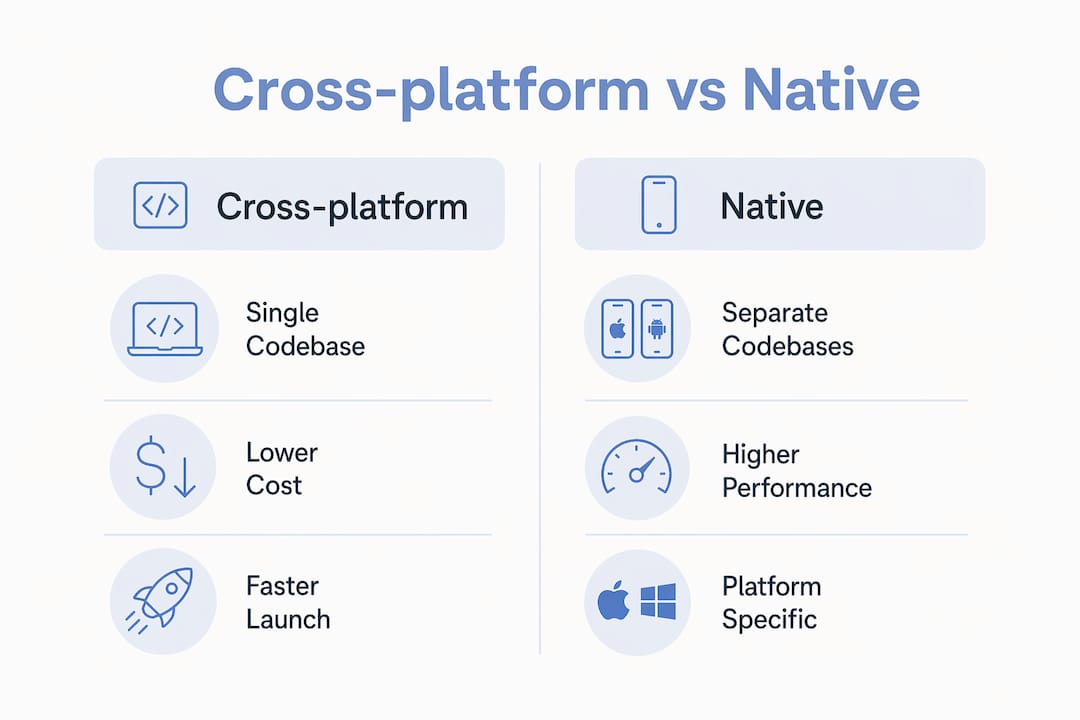
The honest answer is that native still wins in narrow, specific scenarios. For the vast majority of startups, cross-platform is the better choice. The table below breaks down the key differences.
| Characteristic | Cross-platform | Native |
|---|---|---|
| Codebase | Single shared codebase | Separate iOS and Android codebases |
| Development cost | 30–40% lower | Higher due to duplicate teams |
| Time to market | 40% faster initial build | Slower, platform-by-platform |
| Performance | Near-native for most app categories | Maximum performance ceiling |
| Maintenance | Centralized, faster updates | Platform-specific updates required |
| Best for | Most business, SaaS, and consumer apps | High-performance gaming, AR, complex hardware |
The performance gap is the most common objection founders raise. The reality is that cross-platform frameworks achieve feature parity with native counterparts for 80% of app categories. React Native and Flutter both render at native speeds for standard UI interactions, data-heavy screens, and network-dependent features. The gap only becomes meaningful for graphics-intensive applications like 3D games or augmented reality tools.
Native development makes sense when your app depends on platform-specific APIs that cross-platform frameworks cannot access cleanly, or when frame-rate performance is the core product. A real-time AR filter app or a console-quality mobile game belongs in native. A SaaS dashboard, a marketplace, a fintech app, or a productivity tool does not.
Long-term maintenance is where cross-platform’s advantage compounds. When Apple or Google releases an OS update, a native team patches two separate codebases. A cross-platform team patches one. That difference in overhead grows every year the product is live.
Which cross-platform frameworks are best for startups in 2026?
React Native and Flutter are the two dominant frameworks, and they serve different startup profiles. Understanding which fits your team is more important than picking the “best” one in the abstract.
React Native is built on JavaScript and TypeScript. It suits startups whose existing developers already work in JavaScript or whose web frontend is built in React. The ecosystem is mature, the community is large, and the hiring pool is deep. Companies like Discord and Shopify have used React Native to ship production apps at scale. For a startup that needs to move fast with a small JavaScript team, React Native is the practical choice.
Flutter is built on Dart, a language most developers learn quickly. Its primary strength is pixel-perfect UI consistency across every platform. Flutter renders its own widgets rather than relying on native components, which means the app looks identical on Android, iOS, and web. Startups building consumer-facing apps where visual polish matters should consider Flutter seriously. Mediakliq builds cross-platform apps using Flutter as a core technology, which reflects where the industry has moved for high-fidelity mobile products.
Both frameworks support native code bridges, meaning you can drop into platform-specific code when you need camera access, biometric authentication, or Bluetooth features. This hybrid approach keeps the bulk of your logic shared while giving you full access to device hardware when required.
- React Native: Best for JavaScript teams, large ecosystem, proven at scale
- Flutter: Best for pixel-perfect UI, consistent cross-platform rendering, fast Dart onboarding
- Both: Support native bridges for hardware features, active open-source communities, strong hiring markets
Pro Tip: Choose your framework based on your current team’s skills, not the framework with the most GitHub stars. A Flutter app built by a team that knows Dart ships faster than a React Native app built by a team learning JavaScript on the job.
For a deeper comparison of available frameworks, Mediakliq’s guide on cross-platform mobile frameworks covers the full landscape for 2026.
What are the strategic business advantages beyond cost savings?
The financial case for cross-platform development is well understood. The strategic case is less discussed, and it matters more as your startup scales.
A single codebase creates a single source of truth for your product. Every feature update, bug fix, and UI change ships to all platforms at the same time. This eliminates the scenario where your Android users are running a version two sprints behind your iOS users. Brand consistency and feature parity across platforms are not just nice to have. They directly affect user trust and retention.
Cross-platform development also frees budget from platform-specific troubleshooting and redirects it toward customer-centric product work. A native team spends engineering hours reconciling platform differences. A cross-platform team spends those same hours building features users actually asked for. That reallocation compounds over time.
“The default development strategy for startups should be cross-platform unless a validated need for native exists, reducing risk and maximizing flexibility.” — devmil.de
Risk reduction is another underappreciated benefit. Native development creates developer silos. Your iOS engineer and your Android engineer accumulate separate knowledge bases. If one leaves, you lose half your platform coverage. A cross-platform team shares context, shares code, and shares institutional knowledge. That resilience matters enormously for a five-person startup.
Regulatory and platform changes are also easier to absorb. When Apple changes its App Store guidelines or Google updates its privacy requirements, a cross-platform team makes one adjustment. A native team makes two, often on different timelines, creating temporary compliance gaps. For startups in regulated industries like fintech or health tech, that difference is not trivial.
What steps should startups take to implement cross-platform development?
The implementation path is straightforward when you follow a clear sequence. Skipping steps is where most startups create problems they spend months fixing.
- Start with cross-platform by default. Choose native only if you have a validated, specific reason. Vague concerns about performance are not a reason. A concrete requirement for 3D rendering or deep hardware access is.
- Choose your framework based on team skills. React Native for JavaScript teams. Flutter for teams prioritizing UI consistency or willing to learn Dart. Both are production-ready and well-supported.
- Plan your native bridges early. Identify which device features your app needs, such as camera, GPS, biometrics, or Bluetooth, before you start building. Integrating native bridges mid-project is more expensive than planning for them upfront.
- Test on real devices from day one. Emulators miss real-world performance issues. Early testing on real devices across both Android and iOS is the single most effective quality practice for cross-platform apps.
- Plan for efficiency decay over time. Cross-platform’s time savings are highest at launch. As your app grows in complexity, the efficiency advantage narrows. Budget for this in your long-term mobile app lifecycle planning.
Common pitfalls include over-relying on emulators, ignoring platform-specific UX conventions, and treating the shared codebase as a reason to skip code reviews. Cross-platform does not mean low-maintenance. It means lower overhead than native, not zero overhead.
Pro Tip: Build your MVP as a cross-platform app and validate your core use case before investing in any platform-specific optimization. Most startups never need to go native at all.
For startups mapping out their first build, the MVP development steps guide from Mediakliq covers the full process from concept to launch.
Key Takeaways
Cross-platform app development is the most practical startup app strategy because it cuts costs, accelerates launches, and covers every major platform from a single codebase.
| Point | Details |
|---|---|
| Cost and speed advantage | Cross-platform reduces development costs by 30–40% and ships initial builds 40% faster than native. |
| Framework choice matters | React Native suits JavaScript teams; Flutter excels for pixel-perfect UI across all platforms. |
| Native bridges fill the gaps | Use native code bridges selectively for hardware features without abandoning the shared codebase. |
| Strategic budget reallocation | Savings from cross-platform development should fund product innovation, not just reduce spend. |
| Plan for long-term efficiency decay | Cross-platform time savings shrink as app complexity grows, so budget accordingly from the start. |
Cross-platform is the default. Treat it that way.
I have worked with enough startup founders to know that the native vs. cross-platform debate gets treated as a technical question when it is actually a business question. The technical arguments for native are real but narrow. The business arguments for cross-platform are broad and apply to almost every startup I have seen.
The founders who get this right treat their app as a living product, not a one-time build. They pick a framework that matches their team, ship fast, and iterate based on real user data. They do not spend six months debating architecture. They build, measure, and adjust.
The founders who get it wrong usually fall into one of two traps. The first is choosing native because it sounds more serious or professional. The second is choosing cross-platform but treating it as a cost-cutting measure rather than a strategic foundation. Both mistakes cost time and money.
My honest view: cross-platform should be your starting assumption in 2026. The performance gap is negligible for the vast majority of business apps. The cost and speed advantages are real and documented. The only question worth asking is whether your specific product has a validated native requirement. If you cannot name it concretely, you do not have one.
— Christopher
How Mediakliq builds cross-platform apps for startups
Mediakliq has delivered over 75 completed projects and more than 100,000 project hours across web, mobile, and AI-driven applications. Their team builds cross-platform mobile apps using Flutter and React, covering the full lifecycle from concept through deployment and ongoing maintenance.
For startups that need to move fast without sacrificing quality, Mediakliq’s cross-platform development services cover everything from initial architecture decisions to production deployment. Their approach treats every app as a long-term digital asset, not a one-time project. If you are ready to build or want to pressure-test your current app strategy, the Mediakliq team is a direct next step.
FAQ
What is cross-platform app development?
Cross-platform app development is the practice of writing one codebase that runs on Android, iOS, web, and desktop. Frameworks like Flutter and React Native make this possible without rebuilding the app separately for each platform.
How much do cross-platform apps save compared to native?
Startups using cross-platform frameworks reduce development costs by 30–40% compared to native builds. Annual maintenance costs can drop by as much as 50% by consolidating code into a single shared codebase.
When should a startup choose native over cross-platform?
Native development is the right choice when the app requires high-performance 3D graphics, augmented reality, or deep access to platform-specific hardware APIs that cross-platform bridges cannot handle cleanly. For most business, SaaS, and consumer apps, cross-platform is sufficient.
Which is better for startups: Flutter or React Native?
React Native suits startups with existing JavaScript teams, while Flutter is the stronger choice for pixel-perfect UI consistency across platforms. Both are production-ready and support native code bridges for hardware-specific features.
Do cross-platform apps perform as well as native apps?
Cross-platform apps achieve feature parity with native counterparts for 80% of app categories. The performance gap is negligible for standard business apps and only becomes relevant for graphics-intensive or hardware-dependent applications.