

A web application framework is a software platform that gives developers a reusable, pre-built structure to build, deploy, and maintain web applications without writing every component from scratch. Understanding what does web application framework mean is foundational for anyone working in modern web development. Frameworks like Django, Express.js, and React handle the repetitive infrastructure work so you can focus on what makes your app unique. They are not optional extras. They are the standard way professional teams ship production-grade software on time and at scale.
What does a web application framework actually do?
A web application framework automates standard infrastructure setup including routing, security, and session management, so developers spend their time on custom business logic instead of plumbing. That shift alone cuts weeks off a typical project timeline.
The key concept behind every framework is inversion of control. With a library, you call the library’s functions when you need them. With a framework, the relationship flips. The inversion of control principle means the framework calls your code at specific lifecycle events rather than you controlling the sequence directly. This is why frameworks enforce structure so effectively.
Here is what a typical framework handles automatically:
- HTTP request routing: Maps incoming URLs to the correct handler functions without manual parsing.
- Session management: Tracks user state across requests using cookies or server-side storage.
- Database interaction: Provides Object Relational Mapping (ORM) tools so you query databases using your programming language instead of raw SQL.
- Authentication: Manages login flows, password hashing, and access control out of the box.
- Output formatting: Renders HTML templates or serializes JSON responses for APIs.
Frameworks also support URL routing, session management, and output formatting as a standardized foundation. That standardization means a new developer joining your team can read your code immediately because the structure follows known patterns.
Pro Tip: If you are deciding between a library and a framework, ask yourself whether you want to control the flow or let a proven structure control it for you. For most production apps, the framework wins.
What are the main types of web application frameworks?
Front-end and back-end frameworks serve completely different parts of the stack, and mixing them up is one of the most common points of confusion for new developers.
Front-end frameworks build the user interface. They run in the browser and handle what the user sees and interacts with. React, Angular, and Vue are the dominant names here. React uses a component model that makes building complex, interactive UIs predictable. Angular is a full front-end platform with built-in tooling for forms, routing, and HTTP. Vue sits between the two in terms of complexity and is often the fastest to learn.
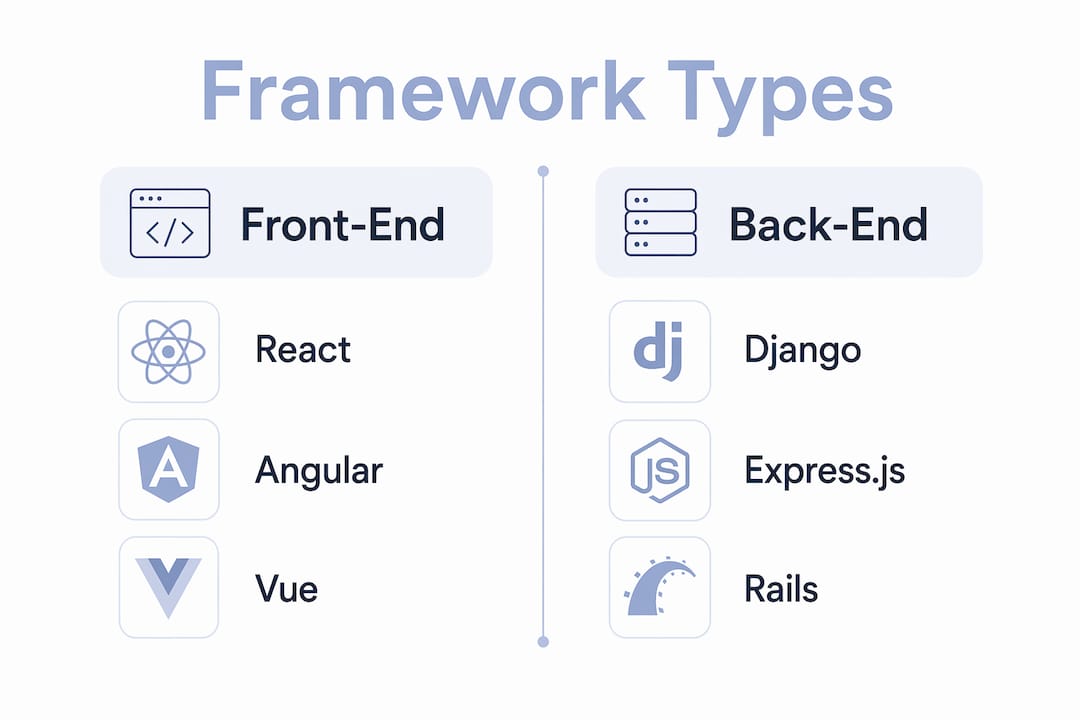
Back-end frameworks run on the server. They handle business logic, database operations, and API creation. Express.js is the minimalist choice for Node.js developers who want flexibility. Django is the Python framework that ships with almost everything built in, from an admin panel to an ORM. Ruby on Rails popularized the “convention over configuration” philosophy that many modern frameworks still follow.
Full-stack frameworks cover both sides. Next.js, for example, extends React to handle server-side rendering and API routes in a single project. Laravel handles full PHP application development including front-end scaffolding.

Web design frameworks like Bootstrap and Foundation focus on responsive grid layouts and consistent UI styling. They are not application frameworks in the traditional sense, but they are part of the broader framework ecosystem every front-end developer uses.
| Category | Examples | Primary Role |
|---|---|---|
| Front-end | React, Angular, Vue | Interactive user interfaces |
| Back-end | Express.js, Django, Ruby on Rails | Server logic, databases, APIs |
| Full-stack | Next.js, Laravel | End-to-end application structure |
| Design/CSS | Bootstrap, Foundation | Responsive layouts and styling |
The right category depends entirely on where your application needs the most structure. Most production apps combine at least two of these.
Why are web application frameworks important?
Frameworks enforce best practices, reduce repetitive coding, and promote maintainability throughout an application’s entire lifecycle. That combination directly lowers the risk of technical debt, which is the hidden cost that kills long-term projects.
Security is the most underappreciated benefit. Building secure HTTP handling, authentication, and session management from scratch is genuinely difficult. Developers are strongly advised to use frameworks for security and network handling because getting these wrong manually creates vulnerabilities that are hard to detect and expensive to fix. Django, for example, protects against SQL injection, cross-site scripting, and cross-site request forgery by default.
“Frameworks provide security measures against common web attacks and simplify high-level networking tasks that are difficult to implement manually.” — MDN Web Docs
Scalability is the other major factor. A framework that works for a 500-user prototype may not hold up at 500,000 users. Choosing one with a strong architecture from the start means you are not rewriting core systems when traffic grows. This is why the web app framework meaning extends beyond just “tool for building websites.” It is a long-term architectural commitment.
Maintainability also improves because frameworks create shared vocabulary. When your entire team uses Django or Express.js, code reviews are faster, onboarding is shorter, and debugging follows predictable patterns.
How do you choose the right web framework?
Framework selection shapes long-term maintenance cost and scalability, making it one of the most consequential early decisions on any project. Getting it wrong costs real money and time, often years after launch.
Use this process to evaluate your options:
- Define your project complexity. A simple content site needs a lightweight framework like Express.js or Flask. A data-heavy enterprise app benefits from Django or Spring Boot’s built-in tooling.
- Match the language your team knows. Switching languages to use a popular framework is almost never worth it. A team fluent in JavaScript will ship faster with Express.js or Next.js than learning Ruby on Rails from scratch.
- Evaluate ecosystem maturity. Check the framework’s GitHub activity, npm or PyPI download counts, and the age of its documentation. A framework with declining community activity is a maintenance risk.
- Review documentation quality. Django’s documentation is widely considered the gold standard. React’s official docs were completely rewritten in 2023 to reflect modern patterns. Poor documentation multiplies development time.
- Check security track record. Review the framework’s CVE history and how quickly the maintainers patch vulnerabilities. This matters more for back-end frameworks handling sensitive data.
Evaluating ecosystem maturity, community support, and documentation quality are the three factors most developers skip when they are excited about a new tool. They pay for that shortcut later.
For scalable builds, your framework choice also connects directly to your broader technology stack decisions. A framework that integrates cleanly with your database, caching layer, and deployment platform reduces friction at every stage.
Pro Tip: If you are new to frameworks, start with one that has strong conventions rather than maximum flexibility. Django or Ruby on Rails will teach you what good structure looks like. You can always move to something more flexible once you understand why the conventions exist.
Key takeaways
A web application framework is the structural foundation that separates professional-grade web development from fragile, hard-to-maintain custom builds.
| Point | Details |
|---|---|
| Core definition | A framework provides pre-built structure that automates routing, security, and session management. |
| Inversion of control | The framework calls your code at lifecycle events, not the other way around. |
| Three main types | Front-end (React, Angular), back-end (Django, Express.js), and full-stack (Next.js, Laravel) serve different layers. |
| Security advantage | Frameworks defend against SQL injection, XSS, and CSRF by default, reducing manual risk. |
| Selection criteria | Match framework to project complexity, team language, ecosystem maturity, and documentation quality. |
Why framework choice is more strategic than most developers admit
I have watched teams spend months debating which JavaScript framework to use, then pick the one with the most GitHub stars. That is the wrong metric. Stars measure popularity at a moment in time. What you actually need is a framework that fits your team’s skill level, your project’s data model, and your client’s five-year maintenance budget.
The most overlooked factor in framework selection is the exit cost. Every framework creates lock-in. Django’s ORM, Rails’ Active Record, and Laravel’s Eloquent all make switching databases or architectures expensive later. That is not a criticism. It is a trade-off you should make consciously, not accidentally.
I have also seen developers reach for full-stack frameworks on projects that only needed a static site generator. Feature-rich does not mean better for every use case. The best framework is the simplest one that handles your actual requirements without leaving you fighting its conventions. For real-time web applications, for example, the framework’s support for WebSockets or server-sent events matters far more than its templating engine.
Start with the problem. Then find the framework that solves it with the least friction.
— Christopher
Build smarter with mediakliq’s framework expertise
Choosing the right framework is only the first step. Building a production-ready application on top of it requires experience across the full development lifecycle.
Mediakliq’s team has delivered over 75 completed projects and more than 100,000 project hours using technologies like React, Laravel, and Flutter. Whether you need a high-performance web application or a custom API-driven platform, Mediakliq handles conceptualization through deployment. Explore Mediakliq’s web development services to see how the right framework choice translates into a product that scales with your business. Ready to start? Visit Mediakliq to discuss your project.
FAQ
What is the definition of a web application framework?
A web application framework is a pre-built software platform that provides standardized structure, tools, and libraries for building web applications. It automates repetitive tasks like routing, session management, and database interaction so developers focus on application-specific logic.
How is a framework different from a library?
A library gives you functions you call when you need them. A framework uses inversion of control, meaning it calls your code at defined lifecycle points, enforcing structure and flow across the entire application.
What are the most popular examples of web frameworks?
Popular front-end frameworks include React, Angular, and Vue. Popular back-end frameworks include Django, Express.js, and Ruby on Rails. Full-stack options like Next.js and Laravel cover both server and client layers in a single project.
Why should developers use a framework instead of building from scratch?
Frameworks provide built-in security against common attacks like SQL injection and cross-site scripting, which are difficult and risky to implement correctly by hand. They also reduce development time and enforce coding patterns that make applications easier to maintain.
How do you pick the right framework for a project?
Match the framework to your project’s complexity, your team’s programming language, and the maturity of the framework’s ecosystem. Review documentation quality and community activity before committing, since both directly affect long-term development speed and support.