

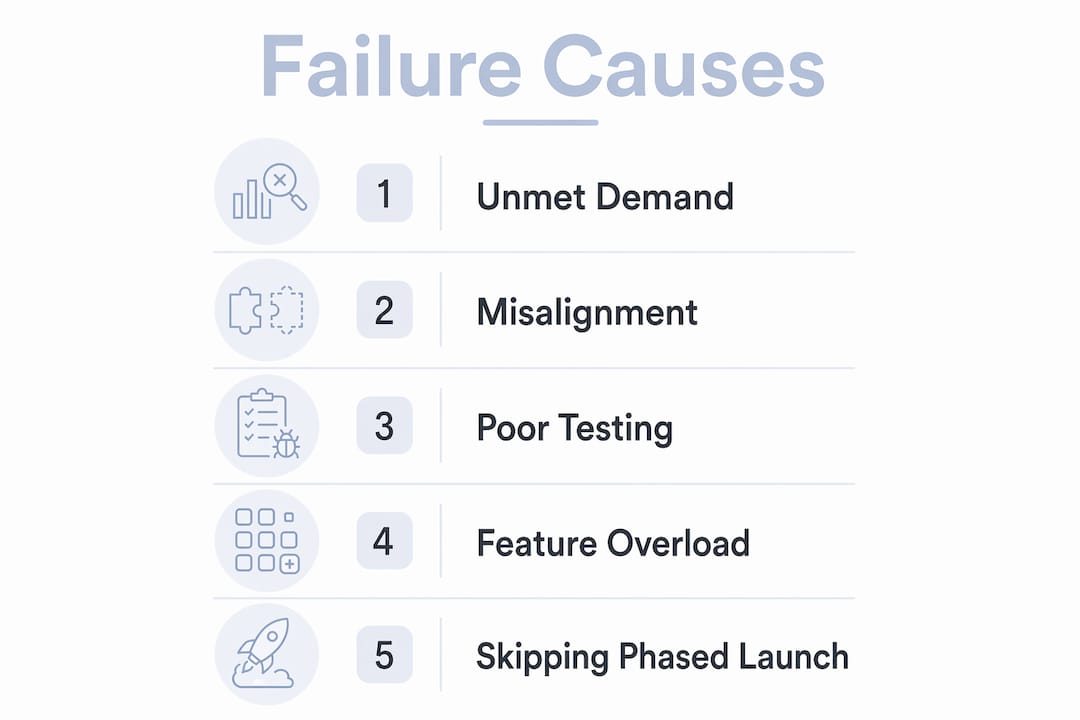
Mobile app launch failure is defined as a product reaching the market without achieving sustainable user adoption, and it kills the majority of startup apps before they find their footing. 35–42% of startups fail because they build products with no real market need. That single cause wipes out more apps than poor code, bad design, or underfunding combined. The three root causes behind why startups fail mobile app launch are lack of validated demand, misalignment between product and marketing teams, and inadequate testing before release. Recognizing these patterns before you ship is the difference between a launch that builds momentum and one that quietly disappears.
Why do startups fail at mobile app launch?
The most common failure pattern is building a product that solves a problem no one is paying to fix. 35–42% of startups cite no market demand as their primary cause of failure. That number has held steady across multiple years of post-mortem research, which means founders keep making the same mistake.
The core problem is confusing stated interest with behavioral evidence. When you ask friends, early followers, or survey respondents if they would use your app, they say yes. That answer costs them nothing. Behavioral evidence like pre-orders and paid pilots is the only reliable predictor of real market fit. Monetary commitment is the signal. Everything else is noise.
Founder networks make this worse. People in your circle want to support you, so their feedback systematically overestimates demand. The fix is to build a demand validation framework before writing a single line of production code. That means running paid landing page tests, charging for early access, or completing a paid pilot with a small group of real users.
- Run a paid waitlist or pre-order campaign before development starts
- Conduct 10–15 structured interviews with people who have no personal connection to you
- Track conversion rates on landing pages, not just traffic or sign-ups
- Use a paid pilot with 20–50 real users to test willingness to pay
User research is a continuous process, not a one-time task before development. Startups that treat discovery as a checkbox activity stop listening to users the moment they start building. By launch day, the product reflects assumptions from six months ago, not current user behavior.
Pro Tip: Build a demand validation scorecard with three columns: assumption, test method, and result. Run it before sprint one, then again at the midpoint of development. If the results shift, your roadmap should shift too.
How does product-marketing misalignment cause app failure?
70% of app launch failures are linked to misalignment between product development and marketing teams. That figure from App Launch Partners points to a structural problem, not a communication style issue. When product and marketing operate as separate workstreams, the launch message rarely matches what the product actually delivers.
The most common version of this failure looks like this: the product team builds features based on technical feasibility, while the marketing team crafts messaging based on what sounds compelling. Neither team checks in with the other until two weeks before launch. The result is a campaign that overpromises and a product that underdelivers.
Marketing must be integrated from ideation, not added at the end. Here is a practical sequence that prevents misalignment:
- Include a marketing lead in product discovery sessions from week one
- Align on a single core user problem the app solves before any design work begins
- Write the launch messaging before the feature list is finalized, then use it as a filter for scope decisions
- Review messaging against the actual product at every major milestone
- Define success metrics together: not just downloads, but 30-day retention and feature activation rates
Vanity metrics are the other side of this problem. Download counts feel like proof of success, but 60% of product teams underestimate the value of post-launch user feedback, which leads to high churn and low feature adoption. A spike in downloads followed by a flat retention curve means your marketing worked and your product did not.
Cash problems are often symptoms, not root causes. CB Insights data shows 43% of startup failures trace back to poor product-market fit. Running out of money is usually what happens after a misaligned launch burns through the runway with nothing to show for it.
Pro Tip: Set a shared Slack channel or weekly sync between product and marketing leads starting at month one of development. Agree on one “north star” metric before launch and report on it together every week post-release.
What testing mistakes cause mobile app launches to fail?
Poor testing is the most preventable cause of launch failure, and it is also the most commonly skipped step under deadline pressure. Poor first-time user experience causes 70%+ drop-off during the first session. One bad onboarding flow or a crash on the first screen ends the relationship before it starts.
The single biggest testing mistake is running all tests on development devices. Development machines are high-end, freshly configured, and running the latest OS. Real users are on mid-range phones from two or three years ago, running older operating system versions. Testing only on development devices creates false stability. The app looks perfect internally and crashes for a large portion of your actual audience on launch day.

Launching with too many features compounds testing problems. Every additional feature is another surface area for bugs, edge cases, and confusing user flows. A focused MVP with five well-tested features outperforms a bloated app with fifteen half-tested ones every time.
| Testing mistake | Prevention method | Launch impact |
|---|---|---|
| Testing only on dev devices | Use a real-device cloud like BrowserStack or Firebase Test Lab | Crashes on mid-range and older OS devices |
| Skipping payment flow tests | Run end-to-end payment tests in staging | Broken checkout causes immediate uninstalls |
| Ignoring permission flows | Test all permission prompts on iOS and Android separately | Users deny permissions and core features break |
| No first-time user experience test | Run 5-session usability tests with new users | 70%+ drop-off in first session |
| Skipping Google Play closed testing | Complete the Google Play closed testing requirement | 3–7 week delays before public release |
Skipping Google Play’s closed testing requirement is a specific mistake that costs founders weeks. Google requires a minimum number of testers and a set testing period before approving a full public release. Teams that skip this step discover the requirement after submission and face a 3–7 week delay at the worst possible moment.
Pro Tip: Start manual testing on the three most common mid-range Android devices in your target market from the first working build. Do not wait for a feature-complete version. Catching device-specific bugs early costs a fraction of fixing them post-launch.
How do phased launches improve startup success rates?
Phased rollouts produce 25% higher user retention than big bang launches, according to a 2025 IAB report. That gap exists because phased launches create a feedback loop that big bang launches destroy. When you release to everyone at once, you have no control group, no clean signal, and no ability to course-correct before the damage is done.
A phased launch works by releasing to a small percentage of users first, measuring behavior, fixing problems, and then expanding. The mobile app MVP development approach fits naturally into this model. You ship the smallest version that tests your core assumption, then iterate based on real data rather than internal guesses.
Post-launch iteration is where most startups lose momentum. The team celebrates the release, deploys the marketing budget, and then waits. That pause is fatal. The post-launch phase requires active resource commitment:
- Run A/B tests on onboarding flows within the first two weeks
- Aggregate user feedback from app store reviews, in-app surveys, and support tickets weekly
- Ship a meaningful update within 30 days of launch to signal active development
- Track feature activation rates, not just session counts
- Identify the top three friction points from user recordings and fix them before expanding the rollout
Maintaining resource commitment after launch is where the product-market fit gap closes. Teams that treat launch day as the finish line watch their retention curves collapse. Teams that treat it as the start of a feedback-driven sprint are the ones that find traction. The continuous delivery approach for mobile apps makes this cadence sustainable at the infrastructure level.
Key takeaways
Mobile app launches fail when founders skip demand validation, separate product from marketing, and test on the wrong devices.
| Point | Details |
|---|---|
| Validate demand behaviorally | Use pre-orders or paid pilots, not surveys, to confirm real market need before building. |
| Integrate marketing from day one | Align product and marketing teams on one core problem and one north star metric before launch. |
| Test on real-world devices | Cover mid-range and older OS devices from the first working build to prevent launch-day crashes. |
| Choose phased over big bang | Phased rollouts produce 25% higher retention by allowing feedback-driven fixes before full release. |
| Commit resources post-launch | Ship a meaningful update within 30 days and track feature activation, not just download counts. |
What I’ve learned from watching startups launch and fail
The pattern I see most often is not a lack of effort. Founders work incredibly hard. The failure usually comes from misplaced confidence in the wrong signals. A founder gets 500 people on a waitlist, interprets that as proof of demand, and builds for six months without charging a single person. Then they launch and discover that free interest does not convert to paid engagement.
The behavioral validation point is the one I push hardest on. Asking someone if they would pay for something is almost useless. Asking them to pay right now, even a small amount, tells you everything. The conversion rate on that ask is your real product-market fit score.
The other thing I see founders get wrong is treating the launch as a discrete event. It is not. The mobile app lifecycle is a continuous loop of build, measure, and learn. The teams that internalize that loop early are the ones that survive past year two. The ones that treat launch day as the goal tend to burn out or pivot within six months of release.
Feature scope is the last thing worth saying plainly. More features do not make a better product. They make a harder-to-test, harder-to-explain, harder-to-retain product. The apps that win in competitive markets are usually the ones that do one thing so well that users cannot imagine switching.
— Christopher
How Mediakliq helps startups launch apps that actually stick
Startups that avoid the failure patterns above share one thing: they had experienced partners guiding the process from concept to post-launch iteration.
Mediakliq works with startup teams across the full app development lifecycle, from demand validation and MVP scoping through phased rollout and continuous delivery. With over 75 completed projects and more than 100,000 project hours, Mediakliq brings direct experience with the testing, team alignment, and iteration challenges that sink most launches. Their mobile app development services cover cross-platform builds in Flutter and React, quality assurance, and post-launch support designed to close the product-market fit gap fast. If your team is preparing for a launch and wants to avoid the most costly mistakes, Mediakliq’s track record speaks for itself.
FAQ
What is the number one reason mobile app launches fail?
35–42% of startups fail because they build products with no real market demand. Founders mistake stated interest for behavioral intent, which leads to launches with no paying users.
How do you validate market demand before building an app?
Behavioral evidence like pre-orders and paid pilots is the only reliable predictor of market fit. Run a paid landing page test or charge for early access before writing production code.
Why does product-marketing misalignment hurt app launches?
70% of app launch failures trace back to product and marketing teams operating without shared goals. When messaging does not match the product, users churn immediately after install.
What is the biggest testing mistake startups make?
Testing only on development devices is the most damaging mistake. Real users on mid-range and older OS devices experience crashes that never appear on a developer’s machine, producing 1-star reviews at launch.
Is a phased launch better than releasing to everyone at once?
Phased launches produce 25% higher user retention than big bang releases. The controlled rollout creates a feedback loop that lets teams fix critical issues before the full audience sees them.