

Real-time features in web app development are defined as capabilities that push data updates to users instantly through persistent connections, without requiring a page refresh. Technologies like WebSockets and SSE form the foundation of this approach, standardized under RFC 6455 and the WHATWG Living Standard respectively. Common use cases include live chat, collaborative document editing, live dashboards, multiplayer games, and activity feed notifications. Choosing the right protocol and architecture from the start determines whether your app scales cleanly or becomes a maintenance burden.
What protocols power real-time features web app development?
Real-time web apps provide instant, bidirectional communication that eliminates the need for users to manually refresh the page. That shift from pull to push is what separates a live experience from a static one. The two dominant transport protocols are WebSockets and Server-Sent Events (SSE), and they are not interchangeable.

WebSockets: full-duplex, bidirectional communication
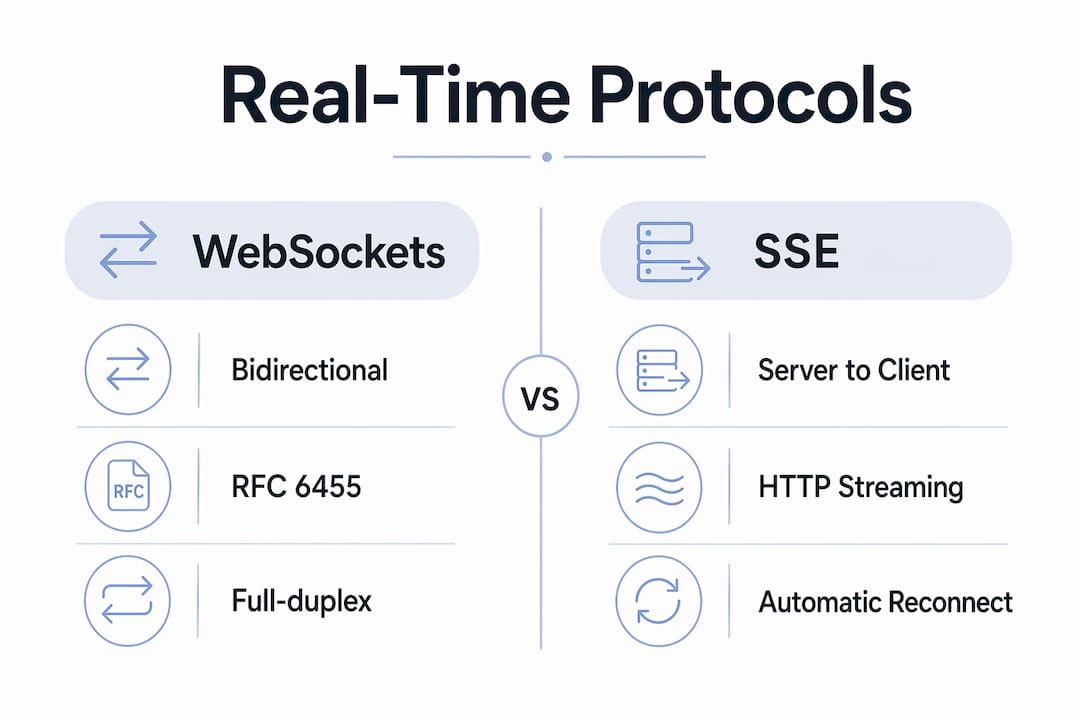
WebSockets deliver full-duplex, bidirectional communication standardized in RFC 6455. Both the client and server can send messages at any time over a single persistent TCP connection. The secure wss:// variant uses TLS tunneling, which helps prevent firewalls and proxies from breaking the connection upgrade. WebSockets are the right choice for chat applications, multiplayer games, collaborative editing tools, and any feature where the client also sends frequent data back to the server.
SSE: unidirectional streaming over HTTP
SSE streams data from server to client over a single HTTP response, with no protocol upgrade required. It includes built-in automatic reconnection and event replay using Last-Event-ID headers, so clients resume exactly where they left off after a dropped connection. SSE passes through proxies and firewalls more easily than WebSockets because it stays within standard HTTP. It is the better choice for live notifications, price tickers, progress bars, and read-only dashboards.
Protocol comparison at a glance
| Feature | WebSockets | SSE |
|---|---|---|
| Direction | Bidirectional | Server to client only |
| Protocol | RFC 6455 (upgrade from HTTP) | HTTP/1.1 or HTTP/2 |
| Reconnection | Manual (must implement) | Built-in with Last-Event-ID |
| Proxy/firewall compatibility | Moderate (TLS helps) | High (native HTTP) |
| Best use cases | Chat, gaming, collaboration | Notifications, dashboards, feeds |
| Complexity | Higher | Lower |
Pro Tip: Start with SSE if your feature only needs server-to-client updates. You get built-in reconnection and simpler infrastructure. Upgrade to WebSockets only when the client genuinely needs to send frequent messages back.
A third option, WebRTC, handles peer-to-peer and media streaming scenarios. Standard polling still works when true real-time delivery is not required. Matching the protocol to the actual use case keeps your stack lean and your infrastructure costs predictable.
What architecture and tools do real-time web apps need?
Event-driven architecture is the standard pattern for live web applications. Instead of clients polling a server on a timer, the server emits events whenever data changes, and connected clients react immediately. This model reduces unnecessary network traffic and keeps latency low.
A common architecture combines three layers: broadcast messaging, presence tracking, and reactive database listeners. Supabase Realtime implements all three through its Broadcast, Presence, and Postgres Changes modes. Broadcast handles low-latency messaging between clients. Presence tracks which users are online and their current state, enabling typing indicators and active user counts. Postgres Changes listens directly to database mutations and streams them to subscribed clients, making live dashboards and collaborative tools straightforward to build.
Core tools and requirements
| Layer | Tool or technology | Purpose |
|---|---|---|
| Transport | WebSocket library or native browser API | Persistent bidirectional connection |
| Streaming | SSE endpoint (Node.js, Laravel, etc.) | Server-to-client event stream |
| Realtime platform | Supabase Realtime | Broadcast, presence, DB change events |
| Database | PostgreSQL with change listeners | Source of truth for reactive data |
| Backend framework | Node.js, Laravel, or similar | Connection management and event routing |
| Frontend | React, Vue, or similar | UI state updates from incoming events |
Integrating database change listeners directly into your real-time layer removes the need for a separate polling layer between your database and your clients. That simplification matters at scale. Architectural choices made early, such as whether to use a managed platform like Supabase or build a custom WebSocket server, directly affect how much infrastructure you manage as traffic grows.
- Use a managed real-time platform for faster initial delivery and built-in scaling.
- Build a custom WebSocket server when you need fine-grained control over message routing.
- Separate your real-time event bus from your REST API to avoid coupling concerns.
- Plan for horizontal scaling from day one. WebSocket connections are stateful, so load balancers need sticky sessions or a shared pub/sub layer like Redis.
How do you build and deploy real-time features step by step?
A structured development process prevents the most common real-time pitfalls. Skipping steps like reconnection testing or load testing under concurrent connections leads to production failures that are hard to reproduce locally.
- Define the feature and its data flow. Identify exactly what data changes, how often, and who needs to see it. A live order status update is different from a collaborative cursor position. Clarity here determines your protocol choice.
- Set up the server endpoint. For WebSockets, create an upgrade handler on your backend. For SSE, create an HTTP endpoint that keeps the response open and writes
data:lines. Test the endpoint independently before connecting a frontend. - Implement the client connection. Use the browser’s native
WebSocketorEventSourceAPI, or a library wrapper. Establish the connection on component mount and close it cleanly on unmount to avoid memory leaks. - Handle message exchange and state updates. Parse incoming messages and update your UI state immediately. For React apps, feed incoming events directly into state or a context store to trigger re-renders.
- Implement reconnection logic. WebSockets require manual reconnection with exponential backoff. SSE handles this automatically, but you should still test that your
Last-Event-IDreplay works correctly after a drop. - Test under realistic conditions. Simulate network interruptions, slow connections, and concurrent users. Tools like Chrome DevTools’ network throttling and load testing scripts reveal issues that unit tests miss.
- Deploy with infrastructure awareness. Configure your load balancer for WebSocket support. Use a pub/sub layer like Redis if you run multiple server instances, so messages reach all connected clients regardless of which server they are on.
Pro Tip: Build your first real-time feature as an isolated proof of concept before integrating it into your main app. A standalone demo with a single WebSocket or SSE endpoint reveals infrastructure gaps without risking your production codebase.
High-performance web applications treat real-time features as first-class citizens in their architecture, not afterthoughts bolted on after launch. Planning the connection lifecycle, message schema, and failure modes upfront saves significant rework later.
What mistakes should you avoid in real-time web app development?
Trying to make every UI element real-time is the most common mistake in live web application projects. Not every piece of data needs a persistent connection. Overusing real-time updates adds infrastructure cost, increases connection overhead, and creates more failure points without delivering proportional user value.
The second most damaging mistake is ignoring reconnection logic. Connections drop. Mobile users switch networks. Servers restart. An app that does not handle reconnection gracefully leaves users staring at stale data with no indication that the connection is lost.
- Overbuilding real-time coverage. Prioritize one or two high-impact features per release. A live notification count delivers more perceived value than real-time updates on every table row.
- Skipping connection state indicators. Show users when the connection is live, reconnecting, or failed. A simple status badge prevents confusion and support tickets.
- Underestimating infrastructure demands. Each WebSocket connection holds server memory. At 10,000 concurrent users, that adds up fast. Plan your server capacity and pub/sub layer before launch.
- Ignoring message ordering and deduplication. Network retries can deliver duplicate events. Build idempotent message handlers that ignore already-processed event IDs.
- Not testing SSE event replay. SSE’s built-in reconnection only works correctly if your server tracks and replays events by ID. Test this explicitly or users will miss updates during reconnects.
“Focusing on single impactful use cases per phase leads to better outcomes than trying to make everything real-time at once.”
Diagnosing connection issues starts with your browser’s DevTools Network tab. Filter by WS or EventStream to inspect message payloads, connection timing, and dropped frames. Server-side logging of connection open, close, and error events gives you the other half of the picture.
Key Takeaways
Real-time web app features require matching the right protocol to each use case, building reconnection logic from the start, and planning infrastructure for concurrent connections before launch.
| Point | Details |
|---|---|
| Protocol selection matters | Use WebSockets for bidirectional needs and SSE for server-to-client streams. |
| Reconnection is not optional | WebSockets need manual backoff logic; SSE handles it automatically with Last-Event-ID. |
| Architecture drives scale | Combine broadcast, presence, and database listeners for a complete real-time layer. |
| Avoid real-time overuse | Prioritize one or two high-impact features per phase to control complexity and cost. |
| Test failure scenarios | Simulate network drops and concurrent load before deploying any live connection feature. |
The real cost of real-time: what experience actually teaches
The hardest lesson I have learned working with real-time web features is that the protocol decision is rarely the bottleneck. Teams spend days debating WebSockets versus SSE, then ship without a reconnection strategy and wonder why users report stale data after five minutes on a mobile network.
The second thing experience teaches is that real-time features are expensive to maintain, not just to build. Every persistent connection is a resource your server holds. Every message schema change is a breaking change for connected clients. I have seen teams add real-time updates to a dashboard because it felt modern, only to spend the next quarter debugging edge cases that polling would have avoided entirely.
My actual recommendation: start with the simplest possible implementation. If SSE covers your use case, use it. If a 30-second polling interval delivers acceptable UX, use that first and measure whether users actually notice. Real-time is a tool, not a feature in itself. The value comes from the user experience it creates, not from the technology underneath.
Mature tools like Supabase Realtime exist precisely because the infrastructure problems are solved. Use them. Save your engineering time for the product logic that actually differentiates your app.
— Christopher
Mediakliq builds real-time web apps that hold up at scale
Real-time features are only as good as the architecture behind them. Mediakliq has delivered over 75 web application projects, accumulating more than 100,000 project hours across the full development lifecycle, from protocol selection and backend architecture through deployment and ongoing maintenance.

If you are planning to add live features to an existing app or build a new one from the ground up, Mediakliq’s web development services cover the full stack, including React, Laravel, and real-time infrastructure. For teams evaluating architecture options, the guide to high-performance web applications covers scalable patterns in detail. Reach out to Mediakliq directly to discuss your project requirements and get a clear technical path forward.
FAQ
What is the difference between WebSockets and SSE?
WebSockets provide full-duplex, bidirectional communication over a persistent TCP connection standardized in RFC 6455. SSE streams data in one direction from server to client over standard HTTP, with built-in reconnection and event replay.
When should I use SSE instead of WebSockets?
Use SSE when your feature only needs the server to push updates to the client, such as notifications, live feeds, or progress indicators. SSE is simpler to implement and passes through firewalls more reliably than WebSockets.
How do I handle reconnection in real-time web apps?
SSE handles reconnection automatically using Last-Event-ID headers to replay missed events. WebSocket connections require manual reconnection logic with exponential backoff to avoid hammering the server after a drop.
What is the biggest mistake in real-time web app development?
Trying to make every UI element real-time is the most common mistake. Focusing on one or two high-impact use cases per release delivers better outcomes and keeps infrastructure complexity manageable.
Does real-time functionality require a special backend?
No special backend is required, but your server must support persistent connections and, for WebSockets, handle the HTTP upgrade handshake. Managed platforms like Supabase Realtime handle much of this infrastructure, reducing the custom code your team needs to write and maintain.