

Flutter is the cross-platform mobile framework that lets startups ship one codebase to iOS, Android, web, and desktop simultaneously. The business case is direct: cutting development costs by 30–40% and reducing time-to-market by 2–3 months versus building separate native apps. For a startup burning runway and racing to validate a product, that math is hard to ignore. Why startups choose Flutter over native comes down to three things: speed, cost, and the ability to reach every platform without doubling your engineering team. Flutter, developed by Google and backed by Dart, has matured into a production-grade choice for teams that need to move fast without sacrificing quality.
Why startups choose flutter over native for mvps
The single biggest Flutter advantage for startups is the single codebase. You write your app once and deploy it everywhere. That sounds simple, but the organizational impact is significant.
With native development, you need an iOS engineer writing Swift or Objective-C and an Android engineer writing Kotlin or Java. Those two teams must stay in sync on every feature, every bug fix, and every UI change. That coordination overhead compounds fast. Flutter collapses that into one team, one language (Dart), and one deployment pipeline.
Here is what that means in practice for resource allocation:
- Hiring costs drop. You recruit Flutter developers instead of two separate platform specialists. The tech hiring market for cross-platform engineers is growing, and Flutter skills are increasingly common.
- Bug fixes ship once. Fix a logic error in your authentication flow and it deploys to both iOS and Android in the same release. No duplicate tickets, no version drift.
- Feature parity is automatic. Native teams frequently ship a feature on one platform weeks before the other. Flutter eliminates that gap entirely.
- MVP cycles compress. Startups using Flutter consistently launch MVPs faster because there is no parallel development track to manage.
Flutter’s Hot Reload feature is worth calling out specifically. Developers see UI changes reflected in the running app within milliseconds, without losing app state. That cuts build-test-iterate cycles from minutes to seconds. For a team validating UX decisions daily, that speed compounds into weeks of saved time over a sprint cycle.
Pro Tip: Structure your Flutter project with a clean feature-first folder architecture from day one. Startups that skip this step early pay a steep refactoring cost when the codebase grows past 50,000 lines.
How does flutter performance compare to native apps?
Performance is the most common objection to cross-platform frameworks, and it is a fair one. Flutter’s answer is architectural. Rather than using a JavaScript bridge or WebView like older frameworks, Flutter compiles directly to native ARM code and renders UI through its own Skia graphics engine.

| Criteria | Flutter | Native (iOS/Android) |
|---|---|---|
| Rendering engine | Skia (own engine, 60fps) | Platform UI components |
| Compilation | Native ARM code | Native ARM code |
| UI consistency | Identical across platforms | Platform-specific look |
| Platform integration | Good, with native plugins | Deep, out of the box |
| Performance ceiling | Near-native for most apps | Highest possible |
| Development speed | Fast (single codebase) | Slower (dual teams) |
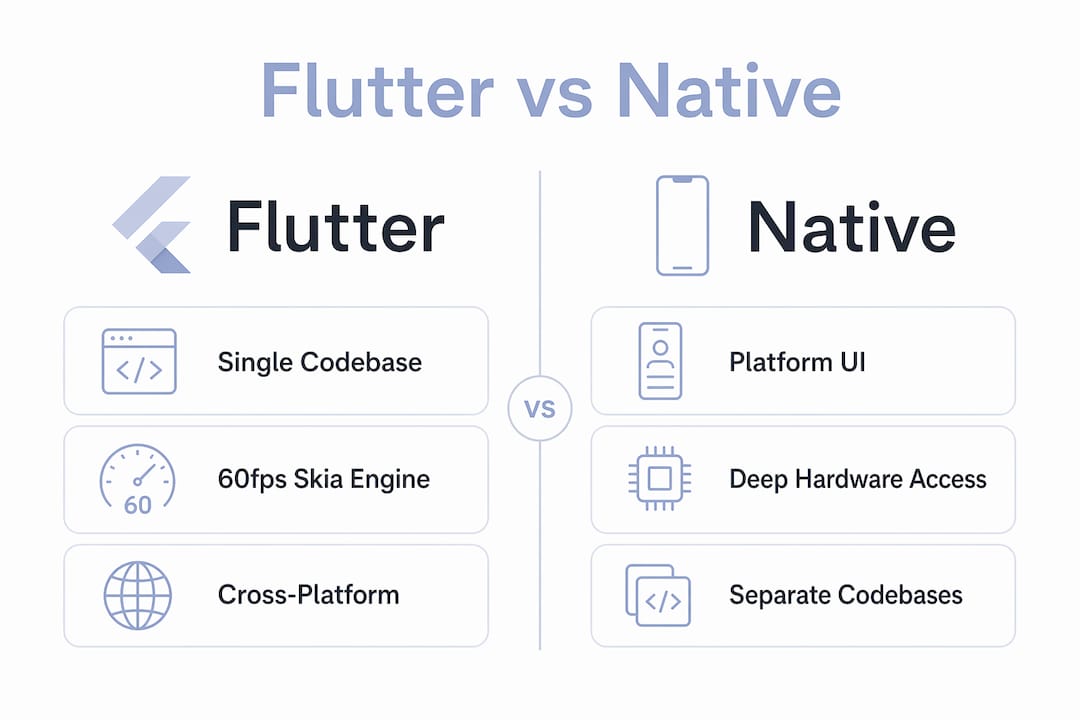
The Skia engine delivers smooth 60fps animations across platforms. For the vast majority of startup apps, including e-commerce, fintech dashboards, social features, and productivity tools, that performance is indistinguishable from native to end users.
Where native still wins is at the edges. Apps requiring deep hardware integration, such as augmented reality with ARKit, advanced camera processing, or Bluetooth Low Energy peripherals, benefit from native development. Native remains compelling when specialized platform APIs are central to the product, not peripheral. If your startup is building a standard mobile product, Flutter’s performance ceiling is more than sufficient.
Pro Tip: Run Flutter’s performance profiler on a physical device, not a simulator, before launch. Simulators mask rendering bottlenecks that show up on real hardware, especially on mid-range Android devices.
Does flutter reduce long-term maintenance costs?
The real organizational impact of Flutter versus native shows up 12–18 months after launch, not at MVP. This is where the key differentiator between the two approaches becomes clear: maintenance efficiency at scale, not raw benchmark performance.
Here is how Flutter changes the maintenance equation as your startup grows:
- One codebase to update. When Apple releases iOS 19 or Google updates Android’s permission model, you patch one codebase. Native teams patch two, test two, and release two.
- Reduced context switching. Developers stay in one language and one framework. Switching between Swift and Kotlin mid-sprint fragments focus and increases error rates.
- Simpler onboarding. New engineers ramp up on one stack. Native teams require platform-specific onboarding for each side of the codebase.
- Consistent test coverage. Maintaining one Flutter codebase means your unit tests, widget tests, and integration tests cover both platforms simultaneously.
- Native plugin integration when needed. Flutter’s platform channel system lets you call native iOS or Android code when a specific hardware feature requires it. You get the best of both worlds without rebuilding the entire app.
The caveat is architecture. Flutter does not automatically produce maintainable code. Teams that skip proper state management patterns, such as BLoC, Riverpod, or Provider, accumulate technical debt fast. The framework gives you the tools. Your team’s discipline determines the outcome. Reviewing common mobile app development mistakes before you start can save months of painful refactoring later.
What do real startup experiences with flutter show?
Real-world startup cases confirm what the cost models predict. Startups adopting Flutter consistently report faster MVP launches and reduced developer hiring costs compared to teams that split resources across native platforms.
The pattern across these cases is consistent:
- Fintech and banking apps built on Flutter ship feature updates to iOS and Android simultaneously, eliminating the user frustration of one platform lagging behind another by weeks.
- Consumer marketplace startups use Flutter to launch on iOS and Android with a team of three to four engineers, a headcount that would typically cover only one platform natively.
- SaaS mobile companions extend their Flutter codebase to web and desktop without a full rewrite, compressing what would be a 6-month expansion into 6–8 weeks.
- Health and wellness apps leverage Flutter’s rich widget library to build polished, custom UI that matches their brand without the cost of custom native components on both platforms.
Flutter’s strong documentation and growing community accelerate these outcomes. The pub.dev package ecosystem now contains thousands of production-ready libraries covering payments, maps, analytics, and authentication. Startups rarely build from scratch. They assemble from proven packages and focus engineering effort on their actual differentiator.
Flutter is ideal when rapid development, multi-platform reach, limited team resources, and fast iteration are the priorities. That description fits nearly every seed and Series A startup. For a deeper look at how Flutter compares to other cross-platform options, the cross-platform framework comparison from Mediakliq covers the full landscape.
Key takeaways
Startups choose Flutter over native because a single codebase cuts costs by 30–40%, compresses time-to-market by 2–3 months, and delivers near-native performance for the vast majority of mobile products.
| Point | Details |
|---|---|
| Cost and speed advantage | Flutter reduces development costs by 30–40% and cuts time-to-market by 2–3 months versus native. |
| Single codebase efficiency | One codebase covers iOS, Android, web, and desktop, eliminating duplicate teams and version drift. |
| Near-native performance | Flutter compiles to ARM code and renders at 60fps via Skia, matching native for most startup use cases. |
| Maintenance scales better | Fixing bugs and shipping updates once across all platforms reduces long-term engineering overhead significantly. |
| Native still wins at the edges | Apps requiring deep hardware integration or specialized platform APIs are better served by native development. |
Flutter in 2026: what i actually think
I have watched the Flutter-versus-native debate play out across dozens of startup engagements, and the teams that get it wrong almost always make the same mistake. They treat it as a technical decision when it is a business decision.
The question is never “which framework is faster in a benchmark?” The question is “what does our team need to ship a product that users love, before we run out of money?” Framed that way, Flutter wins for most startups, most of the time. The 30–40% cost reduction is not a marketing claim. It shows up in payroll, in sprint velocity, and in the ability to respond to user feedback without a two-week lag while the Android team catches up to what iOS shipped last month.
What I tell startup founders directly: Flutter’s architecture flexibility is both its strength and its trap. The framework does not enforce good patterns. I have seen Flutter codebases that were clean and fast to iterate on, and I have seen Flutter codebases that were a disaster by month six. The difference was always team discipline and architecture decisions made in week one, not the framework itself.
Native development is the right call when your core product depends on something Flutter cannot reach without significant workarounds. ARKit-heavy experiences, advanced Bluetooth peripherals, and deep OS-level integrations are legitimate reasons to go native. But those use cases are the exception, not the rule. For a productivity app, a marketplace, a fintech tool, or a social product, Flutter gives you everything you need and gets you there faster.
The community and tooling in 2026 have removed most of the remaining objections. Dart is a mature language. The pub.dev ecosystem is deep. Google’s investment in Flutter is consistent. If you are still on the fence, the risk of choosing Flutter is far lower than it was three years ago.
— Christopher
Build your flutter app with Mediakliq
Choosing Flutter is the right call for most startups. Executing it well is a different challenge.

Mediakliq has delivered cross-platform mobile apps across fintech, SaaS, and consumer markets, with over 75 completed projects and more than 100,000 project hours behind us. Our Flutter development practice covers the full product lifecycle: architecture planning, MVP build, iterative feature development, and long-term maintenance. We work with startups that need to move fast without accumulating technical debt that stalls growth later. If you are evaluating Flutter for your next product, explore Mediakliq’s mobile development services to see how we structure Flutter engagements for startup timelines and budgets.
FAQ
How much does flutter save compared to native development?
Flutter reduces development costs by 30–40% compared to building separate native iOS and Android apps. The savings come from a single codebase, one engineering team, and unified maintenance.
Is flutter fast enough for a production app?
Flutter compiles to native ARM code and renders at 60fps using the Skia engine, delivering performance that is near-native for the vast majority of mobile applications. The gap with native only becomes relevant for apps requiring deep hardware integration.
When should a startup choose native over flutter?
Native development is the better choice when your app’s core functionality depends on specialized platform APIs, advanced hardware features like ARKit, or deep OS-level integration that Flutter’s plugin system cannot cover efficiently.
How does flutter handle updates across iOS and android?
Flutter’s single codebase means bug fixes and feature updates deploy to both iOS and Android in the same release cycle. There is no duplicate development effort or version lag between platforms.
What state management should a flutter startup use?
BLoC, Riverpod, and Provider are the three most widely adopted state management patterns in production Flutter apps. Choosing one and applying it consistently from the start is more important than which specific pattern you pick.