

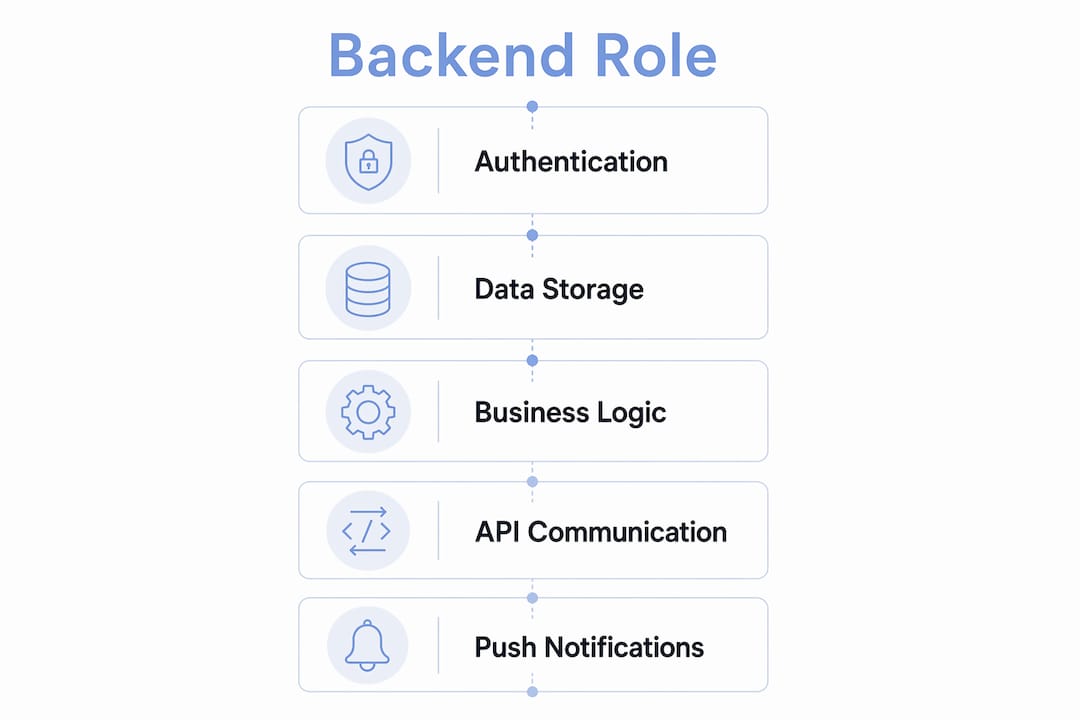
The backend in mobile apps is the server-side infrastructure that manages data storage, user authentication, business logic, and API communication, enabling everything that happens beyond the user interface. Without a backend, a mobile app is a static shell. The role of backend in mobile apps covers authentication, real-time data sync, payment processing, push notifications, and business rule enforcement. About 80% of commercial apps require this infrastructure from day one. That figure reflects how few apps can survive as purely client-side experiences. Backend-as-a-Service (BaaS) solutions, serverless architectures, and custom backends each serve different needs, and choosing the wrong one carries serious financial consequences.
What are the core components of mobile app backend architecture?
Backend architecture for apps is not a single system. It is a set of layered components that each handle a distinct responsibility. Understanding those layers is the foundation of every good mobile app server role.
The core components include:
- Controllers: Handle incoming HTTP requests and route them to the right service.
- Services: Contain business logic, the rules that define how your app actually behaves.
- Repositories: Manage data access and communicate with the database layer.
- Authentication middleware: Validates tokens and enforces access control before any request reaches business logic.
- Message queues: Decouple time-sensitive operations like sending emails or processing payments from the main request cycle.
- File storage: Manages binary assets such as images, documents, and media files.
A layered backend design with clear API contracts, centralized validation, and separated repositories prevents one layer’s changes from breaking the others. That separation is what keeps a codebase maintainable as the app grows.
The most common mistake developers make is mixing business logic with database queries. Mixing these two concerns produces brittle code that breaks whenever a schema changes or a business rule evolves. The correct approach uses three distinct model types: request/response models (DTOs) for API contracts, domain models for business logic, and persistence models for the database. Each layer changes independently without triggering widespread refactoring.
Pro Tip: Never let your ORM models double as your domain models. Define a separate domain object for each core entity, and map between layers explicitly. This single habit prevents the majority of backend rewrites.
The mobile app lifecycle depends on these backend components working together. Authentication gates every session. The service layer enforces every rule. The repository layer persists every state change. When one layer is poorly designed, the entire app pays the price.

How does the backend affect app scalability, performance, and user experience?
Backend choices directly determine whether an app survives its first traffic spike or collapses under load. This is not a theoretical concern.
62% of app teams switch backends within 18 months, incurring average rebuild costs between $50,000 and $200,000. That statistic means the majority of teams that choose a backend without planning for scale end up paying to rebuild from scratch. The cost is not just financial. Rebuilds delay features, erode user trust, and create technical debt that compounds over time.
The three main infrastructure options each handle scale differently:
- BaaS (Backend-as-a-Service): Fastest to deploy. Handles authentication, storage, and real-time sync out of the box. Best for apps with standard data models and predictable traffic.
- Serverless: Scales automatically with traffic spikes. Eliminates server management. Best for apps with uneven or unpredictable load patterns.
- Custom backend: Full control over architecture, data models, and performance tuning. Required when business logic is complex or when regulatory requirements demand it.
Caching is one of the highest-impact performance levers available. A backend that caches frequently read data at the service layer reduces database load dramatically. Real-time sync, handled through WebSockets or server-sent events, requires a backend designed for persistent connections, not just stateless HTTP. Fault tolerance requires circuit breakers and retry logic at the service layer, not at the client.
Pro Tip: Design for mobile app scalability before you need it. Adding horizontal scaling, caching, and queue-based processing after launch costs far more than building them in from the start.
The user experience impact of backend decisions is direct. Slow API responses produce slow screens. Poorly designed authentication flows produce login failures. A backend that cannot handle concurrent writes produces data conflicts. Every backend decision is a UX decision.
What are the latest backend development trends for mobile apps in 2026?
Backend development in 2026 looks fundamentally different from five years ago. AI integration, architectural shifts, and changing developer roles are reshaping how backends are built and maintained.
The most significant shift is the integration of AI-powered systems into backend infrastructure. Retrieval-Augmented Generation (RAG) and large language model (LLM) integrations are now standard features in production backends, not experimental additions. RAG allows apps to query private data sources through an LLM without exposing raw data, enabling intelligent search and recommendation features at the backend level.
AI coding agents are also changing how backend developers work. Tools like Claude Code and GitHub Copilot automate boilerplate generation, test scaffolding, and documentation. This shifts developer time toward architecture design, code review, and quality assurance rather than manual implementation. Full-stack developers now allocate the majority of their time to backend tasks, reflecting how much more complex server-side work has become.
Other trends shaping mobile backend technology in 2026:
- Edge computing: Moving backend logic closer to the user reduces latency for time-sensitive operations like authentication and content delivery.
- Event-driven architecture: Decoupling services through event streams improves fault isolation and makes backends easier to extend.
- GraphQL over REST: Giving clients precise control over data shape reduces over-fetching and improves mobile performance on constrained networks.
- Zero-trust security models: Treating every internal service request as potentially hostile, enforcing authentication at every layer, not just at the API gateway.
The US Bureau of Labor Statistics projects 25% growth in software developer employment from 2022 to 2032, with backend roles driving significant demand. That growth reflects how central server-side infrastructure has become to every digital product. Understanding the technology stack options available for backend builds is now a core competency, not an optional specialization.
How to choose the right backend infrastructure for your mobile app
The right backend choice depends on three factors: app complexity, expected scale, and team expertise. Getting this decision wrong is the most expensive mistake in mobile app development.
| Infrastructure type | Best fit | Key trade-off |
|---|---|---|
| BaaS (e.g., Firebase, Supabase) | MVPs, standard data models, small teams | Limited control over business logic and data structure |
| Serverless | Spiky or unpredictable traffic, event-driven features | Cold start latency, complex debugging |
| Custom backend | Complex business logic, regulatory requirements, large scale | Higher upfront cost, longer build time |
BaaS solutions fit about 80% of apps at the startup or MVP stage. That does not mean BaaS is always the right choice. If your app requires complex pricing logic, multi-tenant data isolation, or custom compliance controls, a custom backend is the correct starting point, even if it costs more upfront.
Domain modeling is the most underrated step in backend selection. Before writing a line of code, map your core business entities and the rules that govern them. Separating business logic from database concerns at the design stage prevents the most common and costly form of technical debt. A domain model that is independent of your ORM survives schema migrations, database swaps, and business rule changes without cascading rewrites.
Team expertise matters as much as technical requirements. A small team with deep Firebase experience will ship faster and more reliably on BaaS than on a custom Node.js or Laravel backend they are learning as they go. The best architecture is the one your team can build, maintain, and extend confidently.
Pro Tip: Write your core business rules as pure functions before choosing a framework or database. If your logic depends on a specific ORM or database type, you have already coupled concerns that should stay separate.
The continuous delivery pipeline for your mobile app also depends on backend infrastructure choices. Serverless and BaaS platforms offer built-in deployment tooling. Custom backends require you to build and maintain that pipeline yourself.
Key Takeaways
The backend is the single most consequential architectural decision in mobile app development, and getting it wrong costs between $50,000 and $200,000 to fix.
| Point | Details |
|---|---|
| Backend powers core app functions | Authentication, data sync, payments, and push notifications all require server-side infrastructure. |
| Layered architecture prevents debt | Separate controllers, services, and repositories to keep business logic independent from database concerns. |
| Infrastructure choice drives scale | BaaS fits most MVPs; serverless handles spiky traffic; custom backends serve complex logic at scale. |
| AI is reshaping backend roles | RAG, LLMs, and AI coding agents shift developer focus toward architecture and quality assurance. |
| Wrong choice is expensive | 62% of teams rebuild their backend within 18 months, at an average cost of $50,000 to $200,000. |
Why I think most teams underestimate the backend until it’s too late
After watching dozens of mobile app projects move from concept to production, the pattern is consistent. Teams spend weeks debating UI frameworks, color systems, and animation libraries. They spend an afternoon picking a backend. That imbalance is where most technical debt originates.
The backend is not a commodity decision. It is the structural foundation that every feature, every user interaction, and every scaling event will test. A poorly designed backend does not fail dramatically on day one. It degrades slowly. Response times creep up. Data inconsistencies appear. Adding a new feature requires touching five files that should never have been coupled. By the time the problem is obvious, the cost of fixing it is enormous.
The AI tools available in 2026 are genuinely useful for backend work. Claude Code and GitHub Copilot can generate boilerplate, write tests, and suggest architectural patterns. But they amplify whatever foundation you give them. A developer who does not understand domain modeling will use AI to produce bad architecture faster. The fundamentals still matter. Separation of concerns, clear API contracts, and domain-first design are not old-fashioned ideas. They are the reason some backends survive years of feature additions while others collapse under the weight of their own shortcuts.
My honest advice: treat the backend decision with the same rigor you apply to your data model. Write down your core business rules before you touch a framework. Choose infrastructure based on what your team can actually maintain, not what sounds impressive in a tech blog. And build for the scale you expect in 18 months, not the scale you have today.
— Christopher
How Mediakliq builds backend systems that hold up under real conditions

Mediakliq has delivered over 75 projects and logged more than 100,000 project hours building backend systems for mobile and web applications. The team works across the full development lifecycle, from architecture design through deployment and ongoing maintenance, using technologies like Laravel, React, and Flutter. For developers and engineering teams that need a backend built to last, Mediakliq’s backend and full-stack development services cover everything from BaaS integration to custom server-side architecture. If you are evaluating high-performance app architectures for your next project, Mediakliq is worth a direct conversation.
FAQ
What does the backend do in a mobile app?
The backend manages data storage, user authentication, business logic, API communication, and push notifications. It is the server-side infrastructure that makes app features work beyond the user interface.
What is the difference between BaaS, serverless, and a custom backend?
BaaS provides pre-built backend services and fits most MVPs. Serverless scales automatically with traffic. Custom backends offer full control and are required for complex business logic or regulatory compliance.
Why does backend architecture affect mobile app performance?
Backend architecture determines API response times, data consistency, and fault tolerance. Poorly structured backends produce slow screens, login failures, and data conflicts that directly degrade the user experience.
How is AI changing backend development in 2026?
AI coding agents like Claude Code and GitHub Copilot automate boilerplate and test generation, shifting backend developer focus toward architecture design, code review, and quality assurance rather than manual implementation.
What is the most common backend mistake in mobile app development?
Mixing business logic with database queries is the most common mistake. It produces brittle code that breaks under schema changes and forces expensive refactoring as the app grows.